
An event is no longer “an evening” — it becomes content
The event industry is changing faster than it seems. Not long ago a good event was judged by its venue, programme and catering. Today clients ask different questions: how much content will remain after the event, how to engage guests who are looking at their phones, and how to prove to management that the budget worked.
We’ve gathered six directions that, in our view, will shape events in 2027 — based on our projects and what’s happening in the market. It’s not an all-encompassing forecast but practical guidance for anyone planning events next year.
6 trends changing events
[секции]
What’s going away
- Long talks with slides. They’re being replaced by short formats, visual stories and on-stage conversations.
- Single-use sets. Structures thrown away after one evening are giving way to modular solutions and digital design.
- Technology for technology’s sake. A VR headset “just because” no longer impresses anyone — an idea is needed.
- “Liked it / didn’t like it” evaluation. Clients increasingly demand measurable results.
How to use trends without overspending
- Start with the event’s goal, not a trendy format.
- Build social media content into the scenario from the start.
- Choose solutions that can be reused — at future events, exhibitions or in the office.
- Agree on success metrics before preparation begins.
If you’re planning an event for next year, take a look at the event solutions we create — we’ll help you choose what will work for your goal.
1. Personalisation with AI
Generative AI has made personalisation scalable: AI photo booths, personal videos for every guest, assistants that answer questions about the programme. The value isn’t the technology but the feeling that “this was made for me” — and the content guests post themselves. The main challenge is speed and quality, so there are no queues at the stand.
2. LED stages instead of backdrops
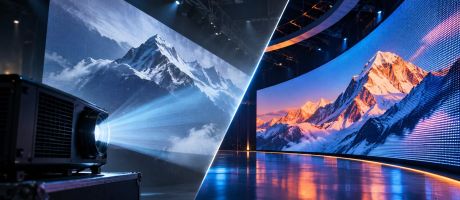
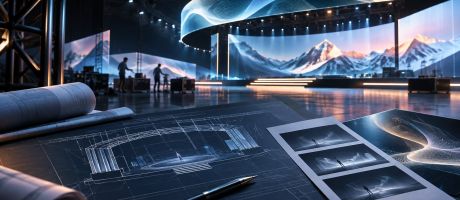
Large LED screens and virtual production technology have arrived on corporate stages. Instead of a printed backdrop there’s a living space that changes for each part of the programme. Such a stage works for the room and the broadcast at the same time, and the design can be updated without new structures.
3. Immersion instead of an auditorium
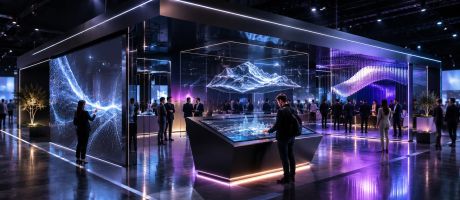
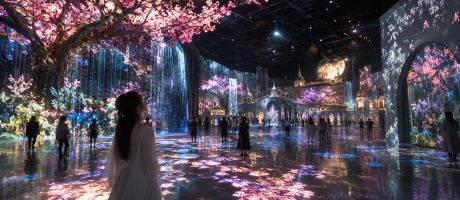
Guests want to be inside the event, not watch it from the side. Projections on walls and floors, spatial sound, scenarios where guests choose their own route. Even conferences and business dinners are increasingly built as spaces with several experience zones rather than one hall with a stage.
4. Reuse and modularity
Economics and ecology agree: everything made for an event should live longer than one evening. Modular structures, digital design instead of print, content that later works in advertising, exhibitions and the office. Clients increasingly ask up front what will remain after the event.
5. Social content built into the scenario
An event is a source of content for months. So the scenario includes “signature shots” from the start: the reveal moment, photo zones, vertical formats, short stories for social media. The event’s audience isn’t just the guests in the room but everyone who sees it in their feed.
6. Measurability
Event budgets are increasingly defended with numbers: registrations, engagement with interactives, contacts collected, reach of posts, enquiries after the event. Digital formats — interactives, QR mechanics, AI photo booths — help collect this data automatically, without forms or manual counting.