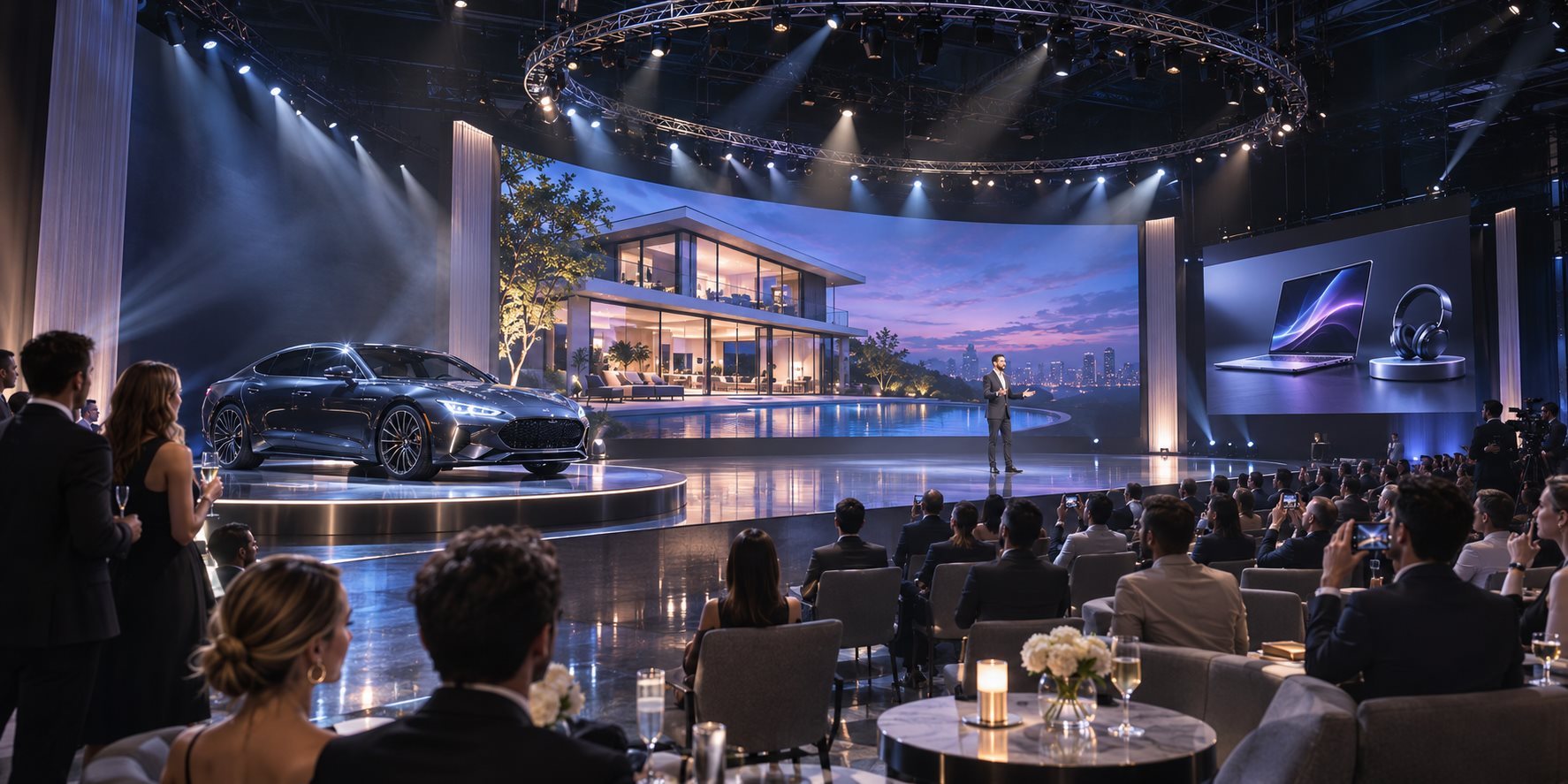

Why a presentation sells better than any brochure
Customers don’t buy specifications — they buy a feeling. How the car will drive, what view will open from the window of a new apartment, how equipment will speed up production. A good product presentation delivers that feeling before the purchase and turns interest into an enquiry.
Yet presenting a car and presenting a residential complex are completely different tasks. Each product has its own buyer, its own sales cycle and its own formats that work. Below are 7 types of presentations and what each one should be built around.
What a product presentation should do
- Show what doesn’t exist yet. A building at the foundation stage, a car before it arrives in the region, equipment that can’t be brought into the hall.
- Explain the complex simply. Technology and benefits through images and action, not tables on slides.
- Create an event. A launch that guests, partners and media talk about.
- Lead to a deal. Give sales managers a reason and material for the next conversation.
7 types of product presentations
[секции]
How to build a launch scenario
- Intrigue. The product is hidden: light, sound and video build anticipation.
- Reveal. The moment the product appears — filmed by guests and media.
- Explanation. A short talk on the key benefits, supported visually on screens.
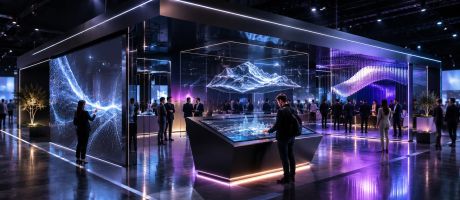
- Immersion. Guests explore the product themselves: interactive, VR, test drive, model.
- Next step. Consultations, bookings and contact collection right on site.
Mistakes that stop a presentation from selling
- Lots of talk, little showing. Long speeches with figures on slides are tiring after 10 minutes.
- A show disconnected from the product. A spectacular programme after which guests can’t remember what was launched.
- One-night content. Videos and visuals that aren’t used after the event in advertising and sales.
- No follow-up plan. Guests aren’t asked to leave contacts, and interest fades.
If you’re preparing a product launch or a sales kick-off, see how we create turnkey product presentations — from idea and scenario to content and the on-site show.
1. Car presentation
A new model launch is a reveal show: the car appears on stage to light, sound and video on a big screen. Projection mapping on the body shows the engine and safety systems, while an interactive configurator lets guests choose colour and trim themselves. A test drive or VR ride completes the experience.
2. Residential complex presentation
Apartments are sold during construction, so the main task is to show what isn’t there yet: the courtyard, lobby, window views and evening lighting. Photorealistic 3D real estate visualisation, mapping on a neighbourhood model and a VR walk through the future apartment work best — and are later used in the sales office too.
3. Equipment and production presentation
Industrial equipment is hard to transport and even harder to explain. 3D animation shows how a mechanism works inside, AR places a machine at full scale, and a virtual factory tour demonstrates the scale of production. This content works both at trade shows and in client negotiations.
4. Tech and electronics presentation
For gadgets and appliances, details and emotion matter: close-ups, feature animation, demonstrations in real-life scenarios. Short product videos, interactive stands where the product can be tried, and 3D content on screens at points of sale all work well.
5. Brand and FMCG product launch
A new drink, cosmetics line or food product launches through experience and reach: an immersive space in the brand’s style, photo zones, 3D videos for screens and social media. The goal is to get people talking and wanting to try it, so content is planned for sharing from the start.
6. Medical equipment and pharma presentation
In medicine, accuracy and clarity matter. 3D animation shows how a drug acts in the body or how diagnostic equipment works, while interactive models help doctors understand the product at conferences and during visits from company representatives.
7. IT product and service presentation
Software or a digital service can’t be touched, so it’s shown through a scenario: how the user’s life changes with the product. Motion videos with the interface, interactive demos on touch screens and a spectacular reveal at conferences and launches work best.