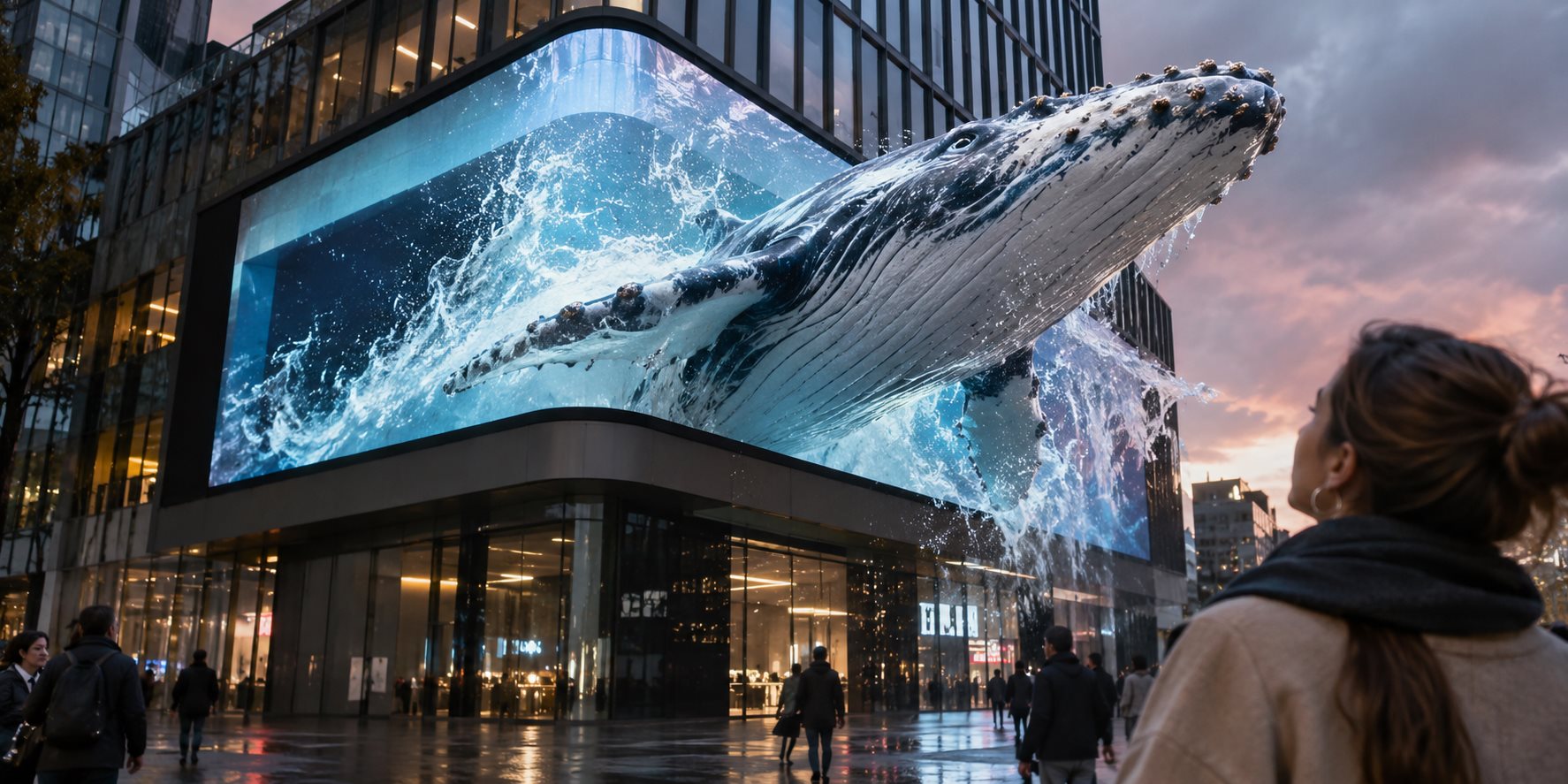

Why people film 3D billboards on their phones
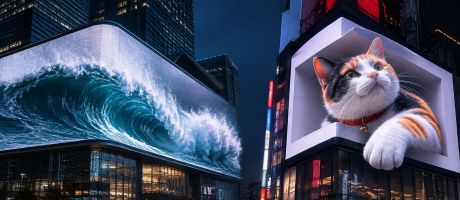
A whale swimming out of the corner of a building, a sneaker flying out of a screen, a bottle that seems to fall onto passers-by — videos like these spread across social media faster than any ad campaign. People stop, film them on their phones and share them themselves.
This is 3D advertising, or anamorphic content for LED screens. The sense of depth isn’t created by special hardware but by precisely calculated perspective. Let’s look at how it works, who it suits and what to consider before production starts.
How 3D advertising differs from a regular video
- It gets noticed. Depth and objects “breaking out” of the screen disrupt the familiar picture the eye has stopped reacting to.
- It gets filmed. The video lives not only on the screen but on social media — viewers spread it themselves.
- It’s memorable. One short, powerful scene with the product at its centre works better than a long story.
- It creates news. Media and bloggers pick up the launch of a 3D video in the city.
How to make a 3D video that works
[секции]
Who 3D advertising is for
- Brands with a striking product. Drinks, electronics, cars, sneakers — anything that looks spectacular in motion.
- Shopping and business centres. A media facade with 3D content becomes a landmark and a meeting point.
- Developers. A 3D visualisation of a future complex right on the facade or a screen at the construction site.
- City events. Openings, holidays and festivals get a striking visual centrepiece.
Mistakes that kill the effect
- A regular video “with depth”. Without calculation for a specific screen and viewpoint, the illusion doesn’t work.
- Too much plot. A passer-by has 5–10 seconds — the video needs one scene and one idea.
- The wrong viewpoint. The effect is calculated for where most people look from, not for a photo in a presentation.
- A dark picture in daylight. Content must be checked against screen brightness and time of day.
Where to start
- Choose a screen or facade and get its exact size, resolution and shape.
- Identify the main viewpoint: an intersection, an entrance, a bus stop.
- Formulate one idea the video should show in 10–15 seconds.
- Approve the storyboard and a test frame before full production.
- Prepare social media versions in advance — that’s where the video will get most of its reach.
If you’re planning a campaign on outdoor screens, see how we create 3D content for DOOH and LED screens — from idea and storyboard to a finished video for a specific location.
1. How the illusion of depth works
The screen stays flat; the depth is created in the viewer’s mind. The 3D scene is rendered for the shape of the screen and the point people look at it from. The effect is strongest on corner screens: the image “bends” at the junction of two planes and the object seems to come out of it.
2. Which screens are suitable
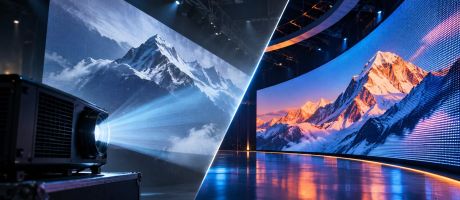
Large corner LED screens and media facades work best: an object can “step out” of the frame. On flat screens the effect is also possible but is built differently — through scene depth, shadows and a frame inside the image. It’s important to know the size, resolution and location of the screen in advance.
3. Scenario: one scene in 10–15 seconds
A passer-by looks at the screen for a few seconds, so the video needs one clear scene: the product appearing, interacting with the city, an unexpected ending. The logo and message come at the end, once attention is captured. Long stories and small text don’t work on an outdoor screen.
4. Production for a specific location
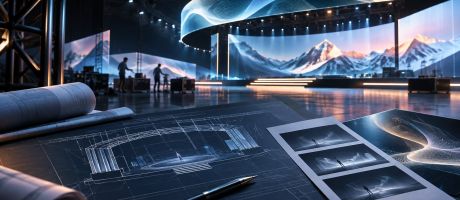
After the storyboard come 3D models, animation and rendering with perspective calculated for the chosen screen. A test frame on site or in an accurate simulation is essential: it checks whether the illusion holds from the main viewpoint and whether the picture reads in daylight.
5. How to extend the video’s life
One 3D video can be used far beyond a single screen: vertical versions for social media, openers for events, content for an exhibition stand or a presentation. That way the production budget works for months, not just one week of placement.