
Why display cases and labels are no longer enough
Fifteen years ago, “interactive” in a museum meant a button that started an audio guide. Today visitors expect something different: they want to step inside history, not just read about it. And if a museum can’t offer that, it loses not to another museum but to shopping malls, cinemas and social media feeds.
The good news is that technology has become more accessible. The bad news is that many museums spend their budget on “trendy hardware” that ends up switched off in a corner a year later. Let’s look at which formats really work and how to avoid other people’s mistakes.
What interactive technologies change
- Time in the hall. Visitors stay where they can do something themselves: turn, choose, launch, compare.
- Audience age. Students and young people come where they can play and create content.
- Repeat visits. Digital content can be updated, giving people a reason to come back.
- Reach. A spectacular hall gets filmed and shared — free advertising you can’t buy with a banner.
7 formats that work in museums
[секции]
Mistakes that make interactive exhibits fail
- Technology for technology’s sake. Start with the story and purpose of the hall, then choose equipment — not the other way round.
- No scenario. A visitor walks up to a screen and doesn’t know what to do. Good interactivity explains itself in 5 seconds.
- No support. Nobody is responsible for updates, repairs and content — and six months later the screen goes dark.
- Not designed for groups. A single-user format in a hall visited by classes of 30 children creates queues and frustration.
- Too much text. A screen you have to read loses to an ordinary label.
Where to start
- Define the main story of the hall and what the visitor should feel on the way out.
- Look at visitor flow: how many people, groups or individuals, how long they stay.
- Choose 1–2 formats for this story rather than five at once.
- Budget for content and support, not just equipment.
- Run a pilot in one hall and watch how visitors react.
If you’re planning to update your exhibition, see how we approach interactive solutions for museums — from concept to launch and support.
1. Touch tables and kiosks
The most familiar format: a screen where visitors browse an archive, explore a map or examine an exhibit in 3D. The main mistake is turning it into a “website on a big screen”. It works when the interface is built like a game or an investigation rather than a menu: “find”, “assemble”, “compare”, “guess the era”.
2. Projection mapping on models
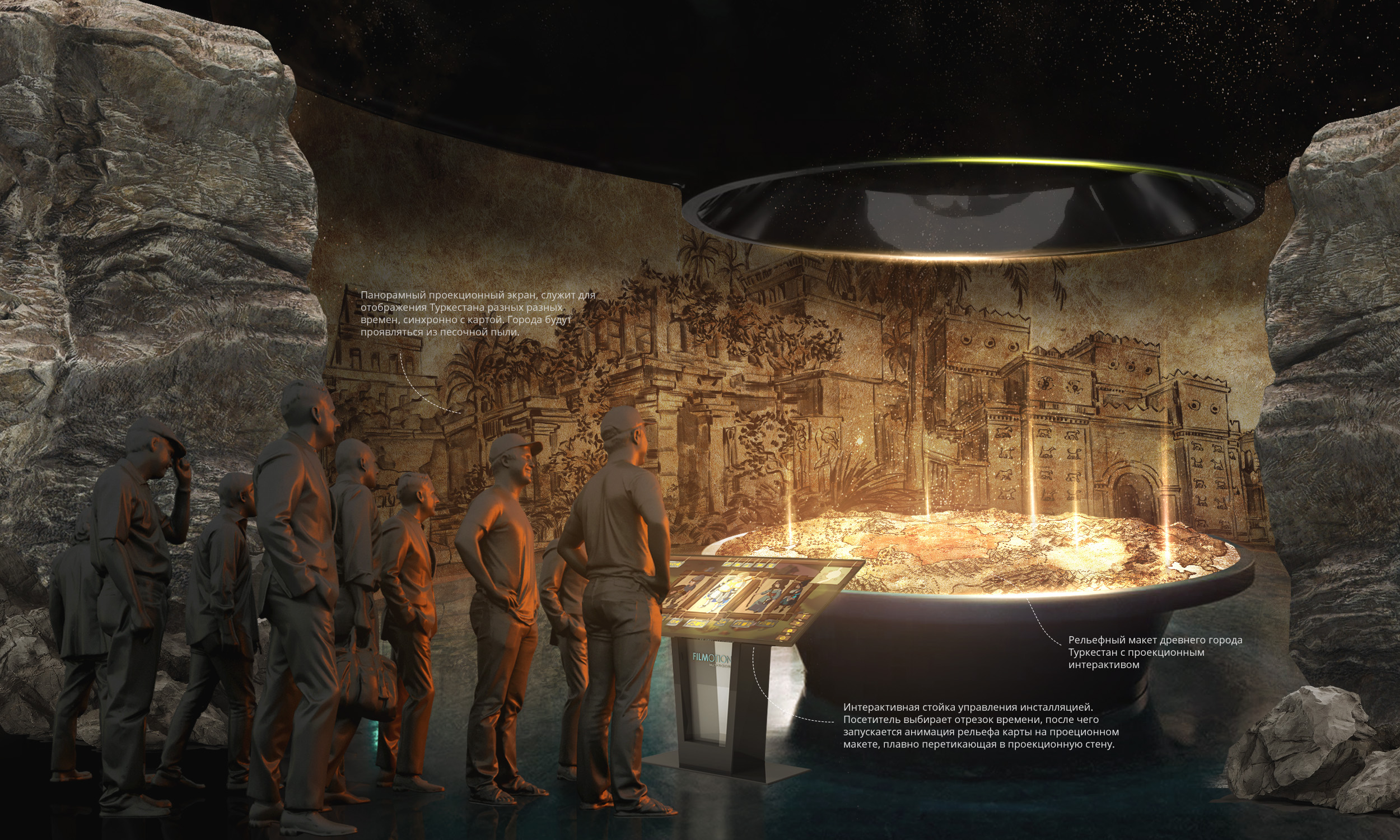
Projection fits the exact shape of a city model, terrain or artefact and brings it to life: how the city was built, how a battle unfolded, how a mechanism worked. Its strength is that it requires no action from the visitor and is clear to any age. Its weakness is that it needs a darkened room.
3. Holograms of historical figures
A historical figure “appears” in the hall and tells the story of their era. For children it’s meeting history through a living person; for adults it’s a strong emotion. In museums, a “hologram” is usually an optical illusion — a projection onto a transparent mesh or screen — and it needs the right lighting and darkness.
4. Augmented reality
A visitor points a smartphone or tablet at an exhibit and sees what a ruined temple looked like, how a dinosaur skeleton moved or what ancient pottery was made of. AR doesn’t require rebuilding the hall. To work, it needs a stable connection and easy access — a QR code instead of an app download.
5. Virtual reality
VR takes visitors where they otherwise couldn’t go: aboard an 18th-century ship, into a mine, into space, inside a cell. It’s the most immersive format but also the most “one at a time”: one headset, one person, a staff member nearby and a short 3–5 minute scenario, otherwise queues form.
6. Digital guide
A new-generation audio guide: an app or a web page opened via QR code that leads visitors along a route, shows photos and videos for exhibits and works in several languages. For a museum it’s a way to give every visitor a tour without expanding staff; for the guest it’s a chance to explore at their own pace.
7. Immersive hall
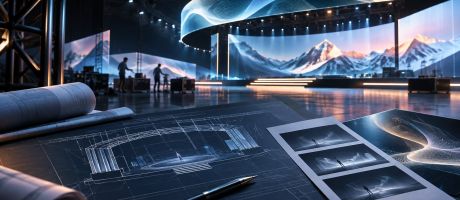
A space where projection covers the walls, floor and ceiling and sound surrounds you from every side. The visitor doesn’t watch history from the outside — they find themselves inside it. An immersive hall becomes the centrepiece of the exhibition and a reason to return if its content is updated regularly.